

Introducing the CCDF
Over the past year, we’ve worked closely with our partners at the Rocky Mountain Institute (RMI) to support the development of the Carbon Crediting Data Framework (CCDF) — a structured, open-source data structure designed to bring greater coherence, comparability, and standardization to the voluntary carbon market.
The foundational CCDF, which can be expanded to accommodate any carbon credit methodology and pathway, synthesizes data from 160+ methodologies, standards, and expert sources to define a common structure for the carbon crediting data that is aligned with quality criteria across the market.
Today, RMI is publishing the CCDF as an open-source toolkit – ready for public feedback and utilization. These tools are designed to help developers, buyers, verifiers, and platforms surface project data in a format that is easier to understand, compare, and validate. The toolkit includes:
- A narrative Executive Report, offering high-level context and design principles;
- An Implementation Spreadsheet, with over 500 fields for project- and credit-level data;
- Technical documentation to support integration;
- A JSON schema, hosted on GitHub, to enable alignment across platforms.
Implementing the CCDF
As RMI’s technical partner, we’ve implemented the CCDF as the foundational architecture of our platform. It serves as the standardized backbone that transforms static project documentation into dynamic, digital records. Bringing the framework to life, we’ve applied the CCDF to 16 distinct methodologies and pathways, ranging from direct air capture to improved cookstoves to afforestation.
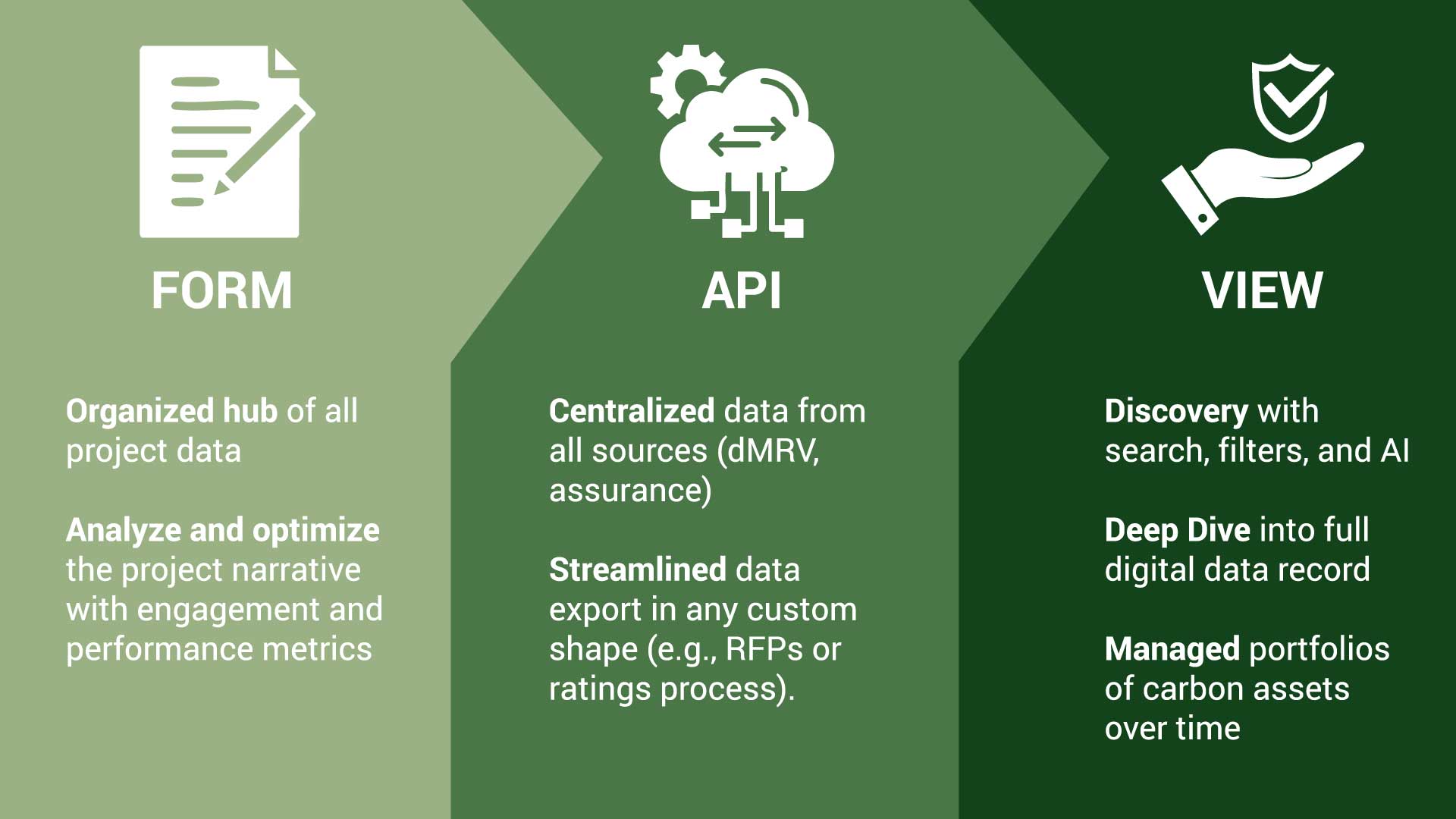
Centigrade provides three core functionalities tailored to different users in the voluntary carbon market. For project developers, the platform offers a structured “Form” — a standardized template that organizes key project data for consistency and clarity. Buyers and other stakeholders can then access the corresponding “View,” which presents that information in a user-friendly format designed to support evaluation of project details and performance. Additionally, Centigrade includes API functionality, allowing seamless integration and data exchange between the platform and other VCM participants, including dMRV providers, credit raters, insurers, and buyers.
The result is a comprehensive digital representation of each project, purpose-built for greater transparency, traceability, and usability across the entire carbon market ecosystem.

Engaging with the CCDF
The CCDF is open-source and intentionally flexible. It was built to help project developers disclose richer, more structured data; to enable credit buyers to identify high-quality projects more efficiently; and to support the market-wide shift toward greater transparency and interoperability. However, like much of what we build at Centigrade and RMI, its value grows with collaboration and feedback. We welcome any and all feedback regarding both the CCDF and Centigrade platform—please don’t hesitate to reach out at carbonmarkets@rmi.org and/or info@centigrade.earth.
You can access the full CCDF toolkit here. To see how it works in practice—and test it out yourself—create a free Centigrade account here.